
Kenya to Host Continental Technology Summit to Drive Africa’s Innovation Agenda
By Victoria Musimbi
Despite ambitious digital strategies and innovation agendas across Africa, many promising ideas continue to struggle to move beyond policy into implementation, limiting the continent’s ability to fully harness science, research and technology for economic transformation.i
To help bridge this gap, Kenya will host the second Africa Technology Leadership Conference (ATLC) 2026, bringing together more than 3,500 government leaders, investors, diplomats, researchers, innovators and private sector executives from over 30 countries to forge partnerships that can accelerate technology deployment, research commercialisation and investment across the continent.
The conference, themed “From Technology Ambitions to Strategic Advantage: Leveraging Science, Research and Innovation for Diplomacy, Capital and Execution,” will take place on October 22 and 23 at the Argyle Hotel in Nairobi. It is being co-convened by the State Department for Science, Research and Innovation (SDSRI), with support from the Ministry of Foreign and Diaspora Affairs, INVIGENCE Ltd and Twinspen Limited.
Speaking during the launch, Pwani University Vice Chancellor Prof. James Kahindi challenged African universities to rethink the purpose of research, saying institutions must move beyond publishing academic papers and instead focus on solving society’s most pressing challenges.
“For many years, research was largely about publishing because we were told to ‘publish or perish.’ But times have changed. We must now undertake research that solves real-world problems, produces innovations, commercialised products and practical solutions capable of transforming lives across Africa,” he said.
He said universities have a critical role in ensuring scientific discoveries are translated into technologies and products that improve livelihoods while supporting Africa’s economic transformation.
The conference has also attracted strong international support.
Evelyn Maris, Deputy Head of Mission at the Embassy of Ireland in Kenya, said Ireland’s economic transformation demonstrated the value of investing in science, technology and young people.
“Ireland’s transformation was driven by deliberate investment in attracting foreign direct investment and supporting young people, particularly in STEM. With 70 per cent of Africa’s population under the age of 30, young people are the innovators who will shape the continent’s future, and their voices must be part of this conversation,” she said.
Maris welcomed continued collaboration with Kenya’s State Department for Science, Research and Innovation, citing the Embassy’s partnership during this year’s Science, Technology and Innovation Week through Young Scientists Kenya.
Similarly, Dr. Fabio Santoni of the Embassy of Italy said Kenya and Italy continue to deepen decades-long cooperation in science, research and technology.
“Our partnership dates back to the 1960s through the San Marco Programme, and today we are expanding cooperation through new agreements in research, innovation and technology. We are also supporting African startups through the AI Hub for Sustainable Development, which aligns well with the objectives of this conference,” he said.
Santoni said Italy remains committed to strengthening collaboration with Kenya under initiatives such as the Mattei Plan while exploring new opportunities in technology diplomacy and innovation.
For Dr. Kenneth Rotich, Chief Executive Officer of INVIGENCE Ltd, the conference represents a turning point in Africa’s technology journey by shifting the focus from discussing challenges to implementing solutions.
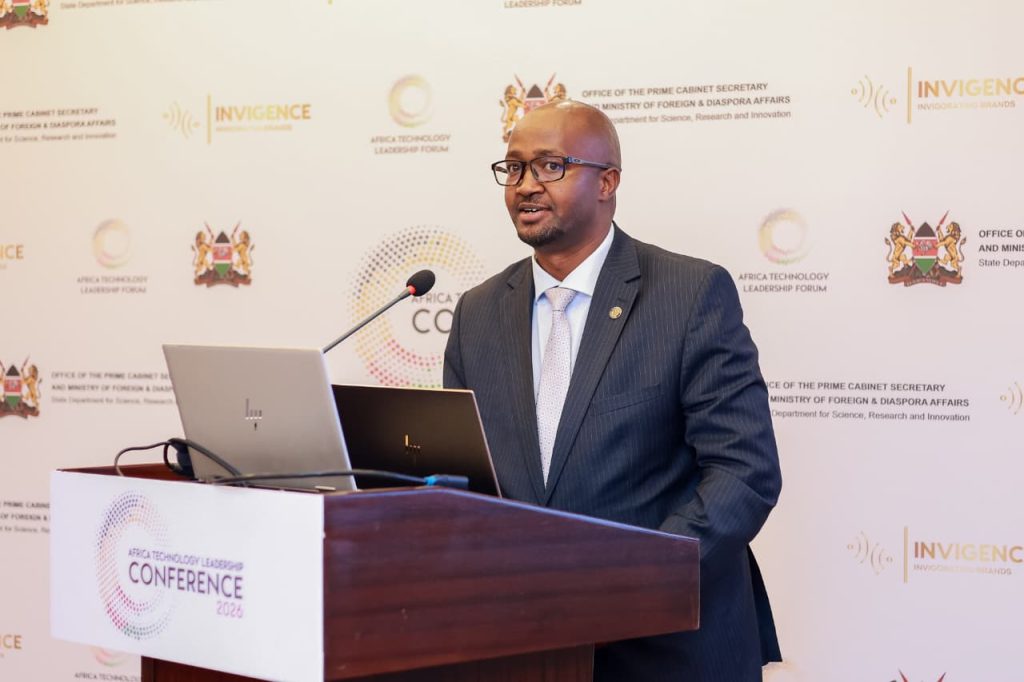
He said Africa must move beyond being viewed as a market for technologies developed elsewhere and instead become a creator of home-grown innovations that respond to the continent’s unique realities.
“For decades Africa has been viewed as the next great market for the world, yet we have remained consumers of finished technologies instead of becoming creators of the solutions we need. The people best placed to build those solutions are Africans who understand our realities, cultures and aspirations.”
Dr. Rotich said the conference will feature curated sessions bringing together governments, diplomats, academia, research institutions, development finance organisations, investors, innovation hubs and private sector leaders to develop practical partnerships that accelerate technology deployment, commercialise research and strengthen Africa’s position in shaping global technology governance.
“ATLC 2026 is about moving from ambition to execution. We want governments, researchers, investors and industry leaders to work together so that ideas move beyond policy documents into investments, institutions and innovations that improve lives across Africa.”
He added that discussions will focus on technology diplomacy, digital infrastructure financing, data governance and research commercialisation while producing practical outcomes, including the ATLC 2026 Communiqué, a post-conference report and the 2026–2027 ATLC Yearbook of Activities.
Principal Secretary for the State Department for Science, Research and Innovation, Prof. Shaukat Abdulrazak, said the Africa Technology Leadership Conference (ATLC) 2026 comes at a defining moment as Africa seeks to strengthen investment in science, research and innovation to drive economic transformation, enhance diplomacy and compete in the global technology landscape.
Speaking during the launch of the conference, Prof. Abdulrazak said the continent must invest more in research ecosystems, scientific talent and innovation if it is to unlock sustainable development and reduce its dependence on technologies developed elsewhere.
He noted that while global investment in research and development continues to rise, Africa still lags behind.
According to UNESCO, global expenditure on research and development reached 1.92 per cent of global GDP in 2023, while Sub-Saharan Africa invested only 0.38 per cent. The region also has 88 researchers per one million people, compared to the global average of 1,486 researchers per million.
“These are not merely differences in statistics. They represent differences in our capacity to generate knowledge, develop medicines, improve agricultural productivity, design advanced technologies, strengthen industries and respond to emergencies. Ultimately, they represent differences in economic competitiveness and global influence,” he said.
He said the figures highlight the urgent need for African countries to strengthen investment in research, innovation and scientific capacity if they are to compete effectively in the global knowledge economy.
Prof. Abdulrazak said Africa must move beyond being a consumer of technologies developed elsewhere and instead become a producer and exporter of home-grown innovations capable of addressing the continent’s development priorities.
“Africa cannot build strategic advantage by remaining only a market for technologies created elsewhere. We must become creators, producers, owners and exporters of technology. We must move from consuming knowledge to generating it, and from importing finished technologies to developing and commercialising African solutions,” he said.
While highlighting Kenya’s progress, he cited the 2026 Economic Survey, which shows the country’s economy grew by 4.6 per cent in 2025, with the information and communication sector expanding by 4.8 per cent. He also referenced the Global Innovation Index 2025, which ranks Kenya among Africa’s leading performers in ICT services exports and venture capital attraction relative to the size of its economy.
However, he noted that Kenya must continue strengthening human capital, research and innovation to maximise these gains and build a competitive knowledge-based economy.
He said the country is working to strengthen the entire innovation value chain from education to research, research to invention, invention to intellectual property, intellectual property to enterprise, and enterprise to domestic, regional and international markets.
Prof. Abdulrazak said technology is no longer just a technical issue but a strategic tool for diplomacy, trade, investment, national security and sustainable development. He added that Kenya is positioning itself to use science, research and innovation diplomacy to attract investment, deepen international scientific partnerships, strengthen local institutions and ensure Africa has a stronger voice in shaping global standards on artificial intelligence, biotechnology, cybersecurity and data governance.
He said the conference will be organised around four strategic pillars: Technology Diplomacy and Leadership; Capital, Investment and Technology Infrastructure; Execution and Institutional Capability; and Trust, Data and Technology Resilience. Delegates will participate in policy dialogues, investment discussions, specialised workshops and technology showcases aimed at producing practical recommendations for governments, academia and industry.
Expected outcomes include the ATLC 2026 Communiqué, policy papers, partnership frameworks and a year-round programme of leadership laboratories and policy dialogues designed to sustain collaboration beyond the conference.
Calling for stronger collaboration among governments, universities, researchers, industry and development partners, Prof. Abdulrazak said Africa already possesses the talent, institutions and markets needed to shape its own technological future.
“Africa is not waiting for its technological future to be designed elsewhere. Africa is ready to help design that future. Let us move from ambition to execution, from research to enterprise, from innovation to measurable impact, and from technology adoption to strategic African leadership.”
