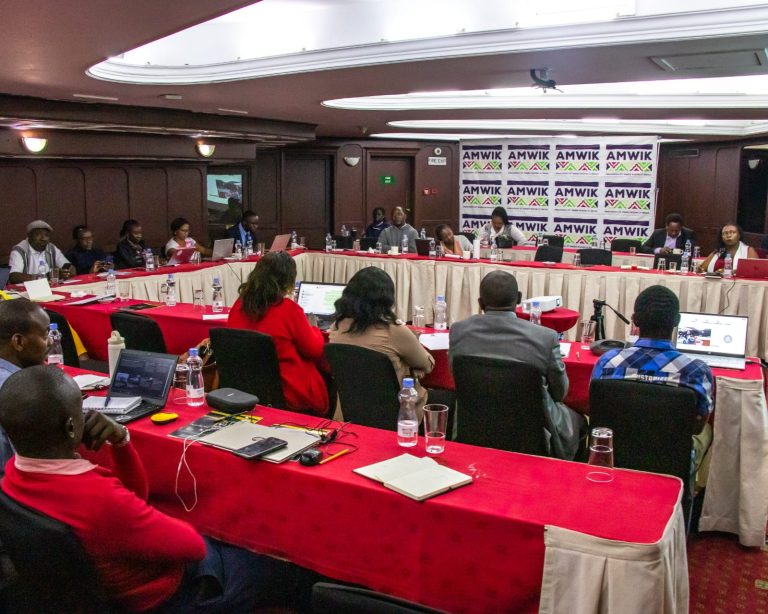
AMWIK, alongside its partners, has launched two crucial reports addressing the widespread issue of sexual harassment within the Kenyan media industry. Titled “Examining Sexual Harassment Policies as the Key to Ending Harassment in the Kenyan Media” and “Identifying Gaps, Limitations, and Effectiveness of Psychosocial and Mental Health Support for Survivors of Sexual Harassment in the Kenyan Media,” these reports shed light on the pervasiveness of this harmful behavior and offer insights, recommendations, and a call to action for stakeholders in the media.
The reports also address the effectiveness of sexual harassment policies in ending harassment within the Kenyan media industry and examines the existing psychosocial and mental health support services available for survivors of sexual harassment in the Kenyan media while identifying gaps and limitations in their effectiveness.
Speaking during the launch, Sharon Kechula, Ag, Executive Director-AMWIK urged the media sector stakeholders to leverage the report and its recommendations to initiate renewed interventions against sexual harassment. She emphasized the importance of adopting sexual harassment policies in national, county, and community media stations as a crucial solution. “The fact that 64% of respondents find current policies insufficient in curbing sexual harassment. This underscores the challenge for the Kenya Media Sector Working Group (KMSWG) to enhance sensitization efforts to encourage the uptake of policies.” She added.
Some of the key findings in the reports include:
- 60% of respondents reported experiencing sexual harassment during their careers, ranging from unwelcome advances to explicit language.
- 70% of the respondents know perpetrators of sexual harassment who are going unpunished
- Despite legal provisions, significant gaps exist between the law and its implementation.
- 87.3% of the participants identified fear of victimization as a major hurdle in addressing sexual harassment in the workplace.
- 46.8% of respondents lack knowledge about safe reporting mechanisms.
- 64% of respondents find current policies insufficient in curbing sexual harassment.
- Over 50% of male respondents attribute harassment to women’s behaviour, contrasting with 37% of women who share this opinion.
- 40% of female interns have experienced sexual harassment, highlighting the vulnerability of entry-level professionals.
The reports also provide wide-ranging implications and recommendations for change which will be discussed in a series of dissemination forums in the country with media professionals, associations, owners, regulators, government agencies, advocates and civil society. The forums will encourage dialogue, share best practices, and collaborate on actionable solutions that collectively address harassment in the Kenyan media.
Winnie Syombua, Gender Lead at Journalists for Human Rights (JHR), highlighted the significant obstacle of job loss fears hindering access to justice for victims. According to the #BreakTheCycleKE report, 70% of journalists are aware of the perpetrators of sexual harassment, yet they often escape punishment. The prevailing concern among journalists is the fear of reprisal, particularly the risk of losing their jobs. This underscores the urgent need for stakeholders to enhance reporting mechanisms to ensure the safety and protection of victims.
The reports can be accessed here:
Report 1 -“Sexual Harassment in the Kenyan Media Landscape: https://amwik.org/wp-content/uploads/2024/02/AMWIK-Research-1-Sexual-Harassment-Report-2024-Feb.pdf
Report 2 – “Identifying Gaps, Limitations, and Effectiveness of Psychosocial and Mental Health Support for Survivors of Sexual Harassment in the Kenyan Media: https://amwik.org/wp-content/uploads/2024/02/AMWIK-Reserch-2-Identifying-Gaps-for-Survivors-2024-Feb.pdf
Follow the online conversation using the hashtag #BreakTheCycleKE